The short answer
The Record machines (530, 730, 830 and 930) are the mechanical classics repairers and owners name; Cale Schoenberg says the 1130’s computerized stitches depend on a circuit board. Before you buy, check the cord, turn every knob, sew a test seam and count the original feet. Dealers we checked sell serviced trade-ins with their own warranty; ask for the terms.
Repairman Cale Schoenberg of The Sewing Machine Shop calls the 830 and 930 Records “among the most iconic sewing machines of the latter half of the 20th century.” Age brings its own problems, though: parts that freeze when a machine sits, electronics that fail, and feet that won’t swap with newer Berninas. Below: which model is which, what to check, and where to buy.
Which Bernina is which: the models by era
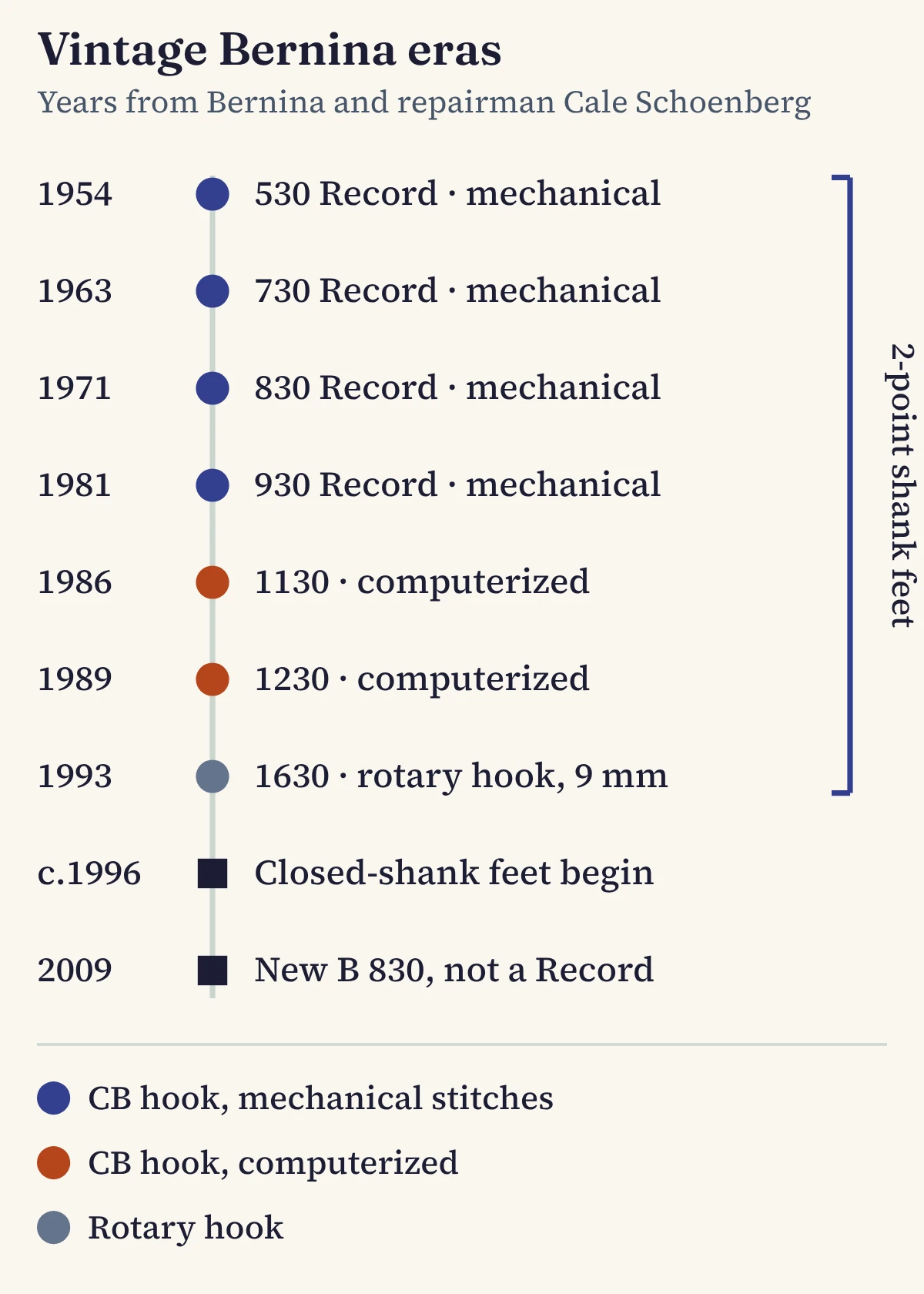
No source we read ranks vintage Berninas against each other. The table sets out what Bernina and named repairers and owners say about each model family, row by row, in date order; the 1008 and 217, with no year in our sources, come last.
| Model and year | What sets it apart | Who says so |
|---|---|---|
| 530 Record (1954) | An early CB-hook machine; without “a little lever sticking down below the stitch width & needle positioning knobs, it won’t have the built in buttonholer” | Cale Schoenberg (year); Becky Rice Ware, vintage machine repair blog |
| 730 Record (1963) | A CB-hook Record from before the 830; an original owner says she uses hers “almost every day” | Cale Schoenberg (year); a reader of his newsletter |
| 830 Record (1971) | “remains the best seller for eleven years and enjoys legendary status today” | Bernina |
| 930 Record (1981) | “the first model with a stretch stitch function and an especially powerful engine”; “essentially mechanical and does not rely on a PCB board to sew” | Bernina; Cale Schoenberg |
| 1130 (1986) | “the first computerized sewing machine with fully automatic one-step buttonholing and stitch pattern memory” | Bernina |
| 1230 (1989) | “expanded memory and fully automated one-step buttonholing” | Bernina |
| 1630 (1993) | “9mm (3/8 in.) stitch width”; a rotary hook, and rotary-hook Berninas are “by far the least common” in his shop | Bernina; Cale Schoenberg |
| 1008 (no year given) | A mechanical machine with a “Patented CB hook” and 17 stitches; “This product is no longer available.” | Bernina |
| 217 (no year given) | “a rare industrial sewing machine that does both straight-stitch and zig-zag” | Cale Schoenberg |
The last digits matter too. Becky Rice Ware notes that “The 931 has 18 stitches, including straight & zig zag, & the 932 also has less stitches than the 930,” and that models whose second two numbers are 40 “were the ‘Favorit model'”, which “uses a different style of bobbin, a faster rotary design.”
Note
The model number 830 alone can mean two machines. Bernina’s history lists the 1971 830 and a 2009 BERNINA 830, “the biggest and fastest machine ever produced at a BERNINA factory.” Cale Schoenberg calls the newer one “a far cry from the 830 Record.” Ask for the full model name, and date the machine from its serial number (step 6 below).
Mechanical or computerized: why it matters for repairs
Cale Schoenberg singles out one split for an old machine: whether the stitches depend on electronics. He explains it with the 930 Record: even if its electronic needle stop failed, “she would still be able to sew on the machine perfectly fine. Owners of vintage machines like the Bernina 1130 or the Viking 960 or the Pfaff 1471 may not have such luck.” Their stitch functions rely on a circuit board, and “Replacing such a component is not easy, as many of these parts are no longer being made.”
The CB hook is the other dividing line. Schoenberg credits the 830 Record’s CB hook (and its easy-open top) for its popularity, and says that “it is impossible to offer 9-millimeter stitch width or automatic thread trimmers on a machine that uses Bernina’s CB Oscillating hook system.” So the CB-hook models before the 1630 top out at what he calls the “5.5-millimeter maximum stitch width of the previous models.”
The all-metal label needs a qualifier. Becky Rice Ware writes that the mechanical Berninas are usually called all metal, but that this is “not technically true, due to there being 2 nylon or plastic gears”. She adds that “In the 700 & 800 series, there were problems with the cam gear & drive gear failing” and that the gears were “apparently subject to recall or something similar”, which she doubts still applies. Against that, Schoenberg’s shop serviced two 830 and two 930 Records and found no notes “regarding timing, needle-hook clearance, feed dog height, tension, broken gears, etc.”
Ware also says the ’30 Records use a Bernina bobbin and bobbin case about 1 mm smaller than class 15 ones. Class 15 bobbins in a Bernina case may wear it early, so she suggests sticking with Bernina bobbins and cases.
What to check before you buy an old Bernina
Each check ends with what a fail means: walk away, or price a repair into your offer.
Check the cord and foot pedal before you plug in
The FDNY Foundation’s cord-safety page is headed “Don’t use frayed or cracked electrical cords.” If the cord, or the pedal’s cable or housing, is cracked or frayed, don’t plug it in to test; for an appliance you want to keep, FDNY says to “contact an electrician to help you. Do not touch it or try to repair it yourself.” An untested machine is a gamble: pass, or price the repair in.
Turn the handwheel and every knob gently, still unplugged
Don’t force a stuck knob; Ware notes two gears are nylon or plastic. Schoenberg’s technician once found an 830 Record where “everything is frozen”: the stitch width knob, the buttonhole knob, the feed dog knob and the tension dial. His explanation: “an old mechanical machine that has been sitting idle for too long is susceptible to freezing up like this.” Stiff knobs or a handwheel that won’t turn mean a service: price it or pass.
Open the bobbin area, still unplugged
Check that the bobbin case is there and is a Bernina one (see above). A missing case or bobbins lowers the price.
Plug in, run it and sew
Sew straight stitch, zigzag and reverse on a scrap, and, if the seller allows, let it run for 15 minutes or so: the owner of one 930 Record that Schoenberg’s shop serviced noticed a burning smell only “after sewing on it for about 15 minutes”. On a 930 Record, check that the needle stops up when you lift your foot; that stop is the part Schoenberg’s technician had to adjust on one machine. Press the pedal lightly: the machine should start slowly and speed up as you press harder. One 830 Record owner on r/sewing says its pedal has a separate speed control, and that “The speed control doesn’t really work on mine so you have to have good pedal control” and would recommend “one with working speed control for when you want to be really precise”, though “you can get by without it”. If you smell burning or see smoke, take your foot off the pedal, switch off and unplug the machine, and don’t run it again (Becky Rice Ware’s first step when a Bernina smokes: “unplug it”). On one 930 Record, Schoenberg’s shop traced the smell to a capacitor that “had blown up from old age”; his technician removed it, and capacitor work is a technician’s job. A burning smell, a pedal that jumps straight to full speed, or a seam that won’t sew cleanly means a repair: price it in or pass.
Count the feet and check they fit
Bernina says “For vintage models, presser feet with the 2-point shank opening are used.” An 830 Record owner on r/sewing found “only original presser feet are suitable, the generic adaptors / feet haven’t worked.” Bernina’s blog lists the 2-point shank models from the 530 Record to the 1630, plus the 1008, and says that “in around 1996” the shank changed to a closed opening, so feet for newer Berninas won’t fit. Missing feet cost money to replace, so count them into your offer.
Date it from the serial number
Bernina of Oklahoma City, a dealer, publishes a chart where the first two digits of the serial number give the year: 11 is 1971 and 20 is 1980. The chart switches to a date code from 2008, so the same two digits can mean two years (50 is 1950 on one list and 2010 on the other); ask a dealer if you’re unsure.
Find the manual and a technician
Bernina posts scanned manuals for machines that are out of print and says “These scanned manuals are available for printing and downloading”; the list covers the 830, 930, 1130 and 1230. Schoenberg warns that aging parts “may not be able to be fixed, especially if you don’t live in proximity to a technician who has experience fixing vintage European machines,” so find one before you buy. Our machine care and setup guides cover upkeep after that.
Quick check
If an in-person seller won’t let you sew on it, think twice. The r/sewing 830 owner’s advice: “I recommend testing the machine before you buy if you can.”
Older Berninas for quilting
The CB-hook Berninas have the basics free-motion quilters ask for, within the 5.5 mm maximum Schoenberg gives for them (the rotary-hook 1630 offers 9 mm):
- Free-motion work. The 830 Record has a knob that sets “whether or not the feed dogs are raised or dropped below the needle plate”, per Schoenberg, and Bernina says the 1008’s “feed-dog can be lowered by simply turning the appropriate control dial”.
- Hands-free lifting. Bernina introduced “the first machine with a patented, knee-activated presser foot lifter” in 1963, and the r/sewing 830 owner notes that hers “also has a knee lift for lifting the presser foot.”
- New feet still exist. Bernina’s 2020 blog says its adjustable ruler, stippling and gliding cup feet come in a version “compatible with early BERNINA models, including the 1630, 1230, 1008, and even with vintage models from the fifties, sixties and seventies, such as the legendary 730 and 830 Record.”
Where to buy a vintage Bernina
| Where | What protects you | Can you test first? |
|---|---|---|
| Bernina dealer trade-ins | The dealer’s own warranty, if it offers one (ask) | Ask the store |
| eBay, Craigslist, Marketplace | No warranty (Schoenberg); check the platform’s own buyer-protection terms; a local cash sale has none | Only if it’s local |
| Estate sales and thrift stores | Usually sold as is; ask about returns | Usually, in person (ask for an outlet) |
A dealer. Dealers sell serviced trade-ins under their own terms (pages read 7 November 2026). High Country Quilts in Colorado says “Every previously loved machine comes with a 1-year High Country Quilts warranty,” and Jon’s Sewing Machines in New York says “These pre-owned machines are fully serviced with a 90 day warranty unless otherwise noted”. Ask for the warranty terms in writing. Bernina’s own warranty (read 7 November 2026) won’t follow the machine: it applies “when the product is owned by the original purchaser” and “is not transferable”.
Online marketplaces. Ware writes that “The older Berninas which are extremely sought after, & bring premium prices on Ebay, include the 500 series, 600 series, 700 series, 800 & 900 series.” Schoenberg, writing about the Bernina 217 on eBay, Craigslist and Facebook Marketplace, notes “there is no warranty with such purchases.” Read the platform’s buyer-protection terms before you pay; a local cash sale has none. One r/sewing commenter on Marketplace buys: “Don’t be afraid to haggle.”
Estate sales and thrift stores. Bargains turn up: an r/sewing commenter has “a bernina 830 purchased at an estate sale which is fantastic.”
On price, Schoenberg names condition and accessories: his shop asks more for an 830 Record “if it is in superb condition and/or if it comes with many of the original accessories.”
When a new machine is the better buy
A vintage Bernina suits someone who sews often. Schoenberg’s conclusion from the frozen 830: “I think it’s fair to say that the 830 Record is not the right machine for a low frequency sewist”. For complete beginners, one r/sewing commenter warns that “with the older machines, especially if you don’t know the condition they’re in, you might have to put a lot more time and energy into actually getting them to a point where you can start sewing.” Others in the same thread disagree; one says a Bernina Favorit is a machine “you might have to grow into, but so what?”
Most new machines also tolerate time off: Schoenberg notes that “most modern sewing machines are not prone to the widespread frozen parts”.
If you’d rather have a new mechanical machine with dials, the Janome HD1000 from our fursuit sewing machine roundup is, in that roundup’s words, “A cast-aluminium mechanical machine with dials”. When we checked on 7 November 2026, a third-party seller (Osewpersonal) held the listing, shipped by Amazon; the box shows the current seller.
| # | Preview | Product | Price | Link |
|---|---|---|---|---|
| 1 |  | Janome HD1000 Heavy-Duty Sewing Machine with 14 Built-In…Simple new mechanical | $399.00 | Check on Amazon |
The sewing machines section lists our other machine guides, including the quilting and embroidery machine roundup.
Ready to buy?
Our fursuit sewing machine roundup compares new mechanical, computerized and straight-stitch machines, with live prices.
Frequently Asked Questions
Q. Which is the best vintage Bernina sewing machine?
No source we read ranks Berninas against each other. Repairman Cale Schoenberg’s list of favorite vintage machines includes the Bernina 217 and the 830 Record, and in another post he writes that, as far as he can tell, the 830 Record is “the most popular vintage machine still in use behind the Singer Featherweight.” An r/sewing commenter recommends “A 1008, or the original 830 or 930”.
Q. How much is a used Bernina sewing machine worth today?
It depends on the model, condition and accessories. Compare recent sales of the same model with its feet and case.
Q. How do I tell how old my Bernina is?
Read the serial number against a dealer’s chart, such as Bernina of Oklahoma City’s, and check whether it is the older serial system or the date code used from 2008.
Q. What are the vintage Bernina models by year?
The 530 Record from 1954, the 730 Record from 1963, the 830 from 1971, the 930 from 1981, the 1130 from 1986, the 1230 from 1989 and the 1630 from 1993.
Q. Are old Berninas all metal?
Not quite. Becky Rice Ware says the mechanical models have two nylon or plastic gears.
Q. What is the lifespan of a Bernina machine?
No maker gives one. Schoenberg’s shop services 830 Records that are “over 50 years old”, and one of his readers calls her 830 her “daily driver”.
Sources (18)
- Bernina, History
- Bernina, BERNINA 1008
- Bernina, Information about BERNINA presser feet
- Bernina blog, height-adjustable presser feet for older machines
- Bernina, out-of-print manuals
- Bernina, BERNINA Warranty, read 7 November 2026
- Cale Schoenberg, The Secret Behind Bernina’s Cult-like Following
- Cale Schoenberg, Examining two Bernina 930 Records
- Cale Schoenberg, Analyzing two Bernina 830 Records
- Cale Schoenberg, Bernina’s Fascinating Trajectory Over the Past 60 Years
- Cale Schoenberg, Top 5 Vintage Sewing Machines
- Becky Rice Ware, Bernina Sewing Machine eBay Guide & Review
- Bernina of Oklahoma City (dealer), year of manufacture
- High Country Quilts (dealer), Previously Loved Machines, read 7 November 2026
- Jon’s Sewing Machines (dealer), Pre-Owned Machines, read 7 November 2026
- FDNY Foundation, frayed or cracked cords
- r/sewing thread, Bernina model for second-hand purchase
- r/sewing thread, choosing a vintage or used machine
Product prices and availability are accurate as of the date/time indicated and are subject to change. Any price and availability information displayed on Amazon.com at the time of purchase will apply to the purchase of this product.